
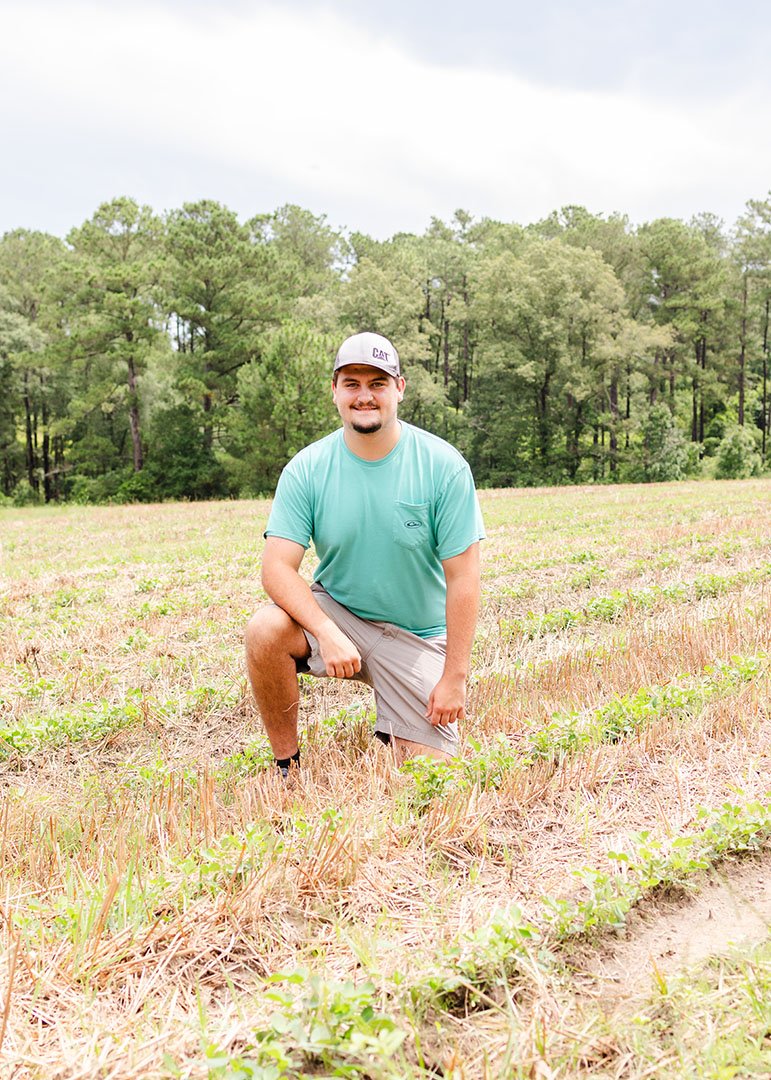
An entrepreneurial spirit, involvement in FFA, and innovation are what earned Fletcher Green the title of the 2025 Alabama FFA Fiber/ Oil Crop Proficiency Award winner, along with State Star Farmer. Green, son of Derrick and Cindy Green, is a first-generation farmer in Geneva County, who began working toward this achievement in the 9th grade.
Fletcher credits his success in FFA to Michael Vann, his agriculture teacher and FFA Advisor, at Geneva High School. “He has been encouraging me since 9th grade,” he reflects. “Helping me find all the awards to apply for that fit all the things I do – like cover crops, peanuts, corn sales.” Not only did Fletcher bring home some of the top awards from the 2025 Alabama FFA Convention, but he also received a $1,000 grant and approximately $1,400 to put toward his school and farming operation.
Green’s agricultural operation has grown from a single acre of green peanuts and five acres of corn into a diverse rotation of about 50 acres that includes oats, corn, and, of course, peanuts. Each expansion came through relentless hustle, thrift, and community connections. He traded labor for equipment use, sourced auction deals on outdated peanut pickers and combines, and paid back every dollar his father fronted—down to the last cent.
Despite the scale, he’s already developed a reputation for quality and uniqueness. His green peanuts, a Virginia Bailey variety, are known for their rich flavor and are sold directly to customers right off the farm. “We have a customer base built up, but we do advertise on social media, just anywhere we can,” Green commented. “And folks, every year, no matter if we have advertised or not, they’re calling me.”
Green only plants one crop of green peanuts a year due to the intensive labor and processing. The green peanut crop has to be handled by hand to clean and stem. With the help of some “inventing”, as Green puts it, he has made his own wash tables with vats to speed up the cleaning process. “We have got it down to where we can process a basket load of peanuts in a day, and we can keep up with our customers,” he said. In 2024, Green let an acre of his peanuts mature and shelled them for seed, which he planted for the 2025 crop. This cut his cost considerably and adds more profitability to his operation.
This year Green will have 14 acres of peanuts – 2 acres of the Virginia Bailey for his green peanut operation and 12 acres of mature peanuts he will take to the buying point to sell. He weighed out the risk of planting more acreage of peanuts. “I can plant late peanuts and make a little money and stretch myself thin, or save $8,000 and have no risk,” Green comments.
Green’s path into agriculture began with a deep childhood fascination. “I didn’t play with Legos or Transformers—I played with tractors,” he said. His father, a machinist by trade, fed that interest by building miniature implements and, eventually, helping his son restore real farming equipment. While Fletcher’s family is not involved in farming, he has learned how to be a mechanic and problem-solve out in the field from his father and other family members. That background is helping Fletcher learn that you are not just a farmer—you’re a mechanic, an engineer, and a businessman, too.
Green didn’t inherit hundreds of acres or shiny new machinery. He works out of a barnyard loaned to him by Mrs. Sharon Turner, the widow of former APPA board member, Charles Turner. “That tractor over there and a little old Ford tractor,” Green points out. “Is what I got started with. I don’t actually farm her land, but for trade-out, I keep the barnyard bush-hogged and weed-eated.” Green also gets use of a grain bin on the property to store his corn.
Green is an advocate for sustainable and efficient practices. Through an NRCS cover crop program, he’s adopted conservation-friendly strip-tilling techniques and reduced herbicide use significantly. “I got a strip-till rig, and you make a 12-inch bed and leave the cover crop stubble in the row middles,” he explains, “and just the amount of moisture you save and weed pressure – I’ve gone from spraying herbicides twice after the corn gets up to just once.”
He’s equally intentional about fungicide and herbicide applications, basing decisions on real-time field conditions rather than fixed schedules. “Every field’s different. You have to go off of what the crop actually needs, and not try to copy what other growers are doing around you.”
Much of what Green knows has been self-taught through trial and error, YouTube videos, and even Google searches. “There are a lot of things I still need to learn,” he said, “The problem is, you don’t realize what you still need to learn until you make the mistake. And I make mistakes every year.” The rest comes from conversations with experienced area farmers— who have not only offered advice but occasionally loaned equipment when Green was in a pinch.
Though agriculture is his passion, Green is realistic. He plans to earn his Airframe and Powerplant license at the Alabama Aviation College in Ozark, Alabama, and work as a civilian aircraft mechanic at Fort Rucker, headquarters of U.S. Army Aviation, in Southeast Alabama —balancing a full-time career with what he calls “a little more than a hobby farm.” His goal is to farm 250 acres part-time with a rotation of peanuts, corn, oats, and maybe cotton.
In every acre he clears, every piece of equipment he revives, and every bushel he sells, Green is quietly building something bigger. Not just a farm—but a future.
###
The Alabama Peanut Producers Association supports Alabama peanut growers through education, promotion and research. APPA sponsors the Alabama FFA Fiber and Oil Crop Proficiency Award.
Article credits: Kaye Lynn Hataway and Kaycee Rippey
Picture credits: Kaycee Rippey