
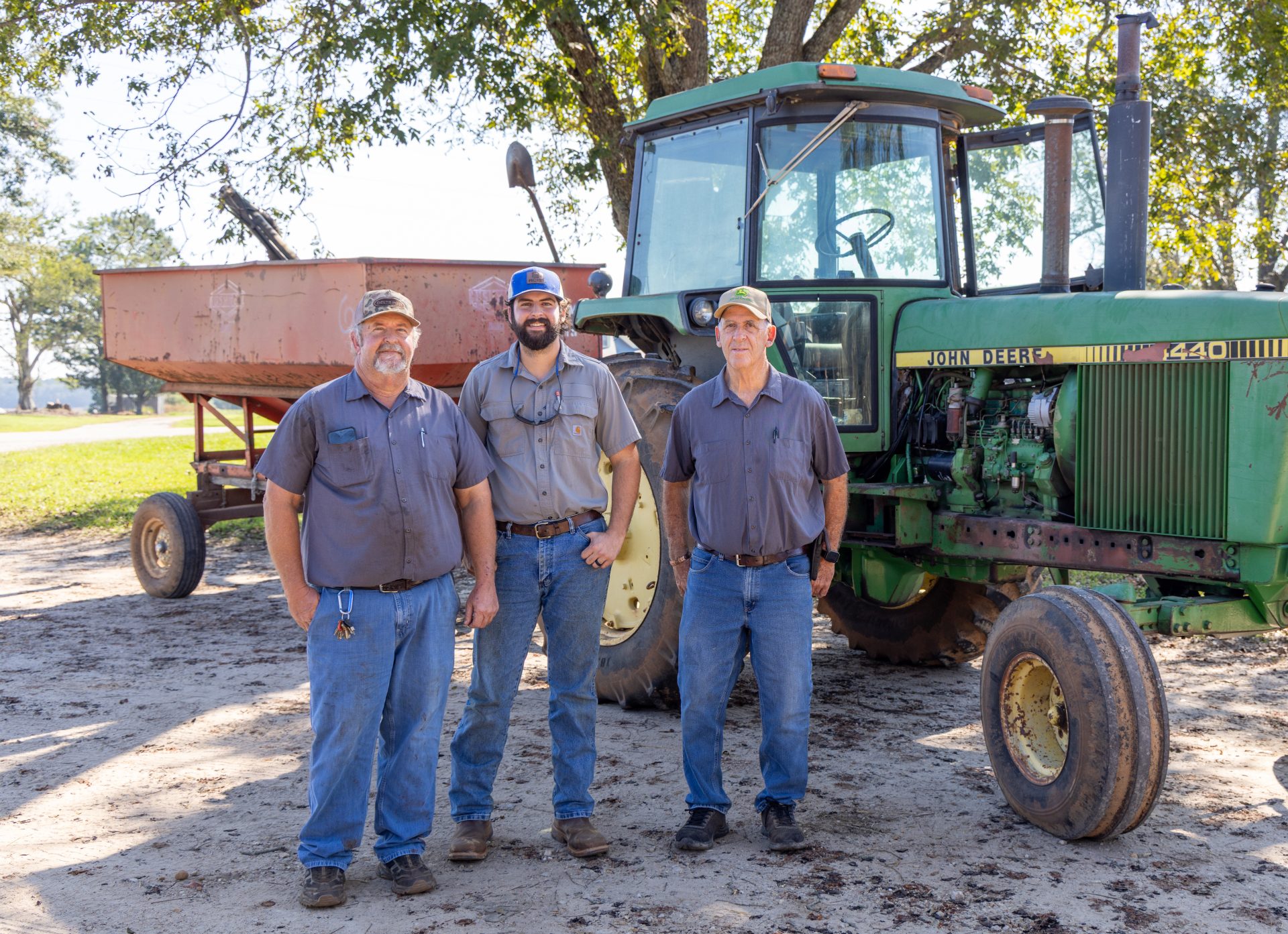
For the Williams family, farming is more than a livelihood. It’s a tradition built on generations of hard work, a willingness to embrace change and a shared commitment to keeping their operation growing.
Just outside Columbia, Alabama, in Henry County, the Williams family is continuing an agricultural tradition that began generations ago. On land once farmed by Andy Williams’ great-grandfather, the family has built a diversified operation rooted in tradition while remaining focused on the future.
Today, the Williams farm produces peanuts, cotton and corn, while also maintaining a cattle herd of approximately 350 to 360 brood cows. With multiple generations working side by side, the operation is a year-round commitment that requires teamwork, careful planning and a willingness to adapt.
For Andy, farming has been a part of life for as long as he can remember. His great-grandfather, grandfather and father all worked the land before him, establishing the foundation for the operation the family manages today.
After graduating from Auburn University, he returned to the family farm in 1979, although his experience behind the wheel of a tractor began much earlier.
“I was farming before that, since I was on a tractor when I was 11 or 12 years old,” he recalled.
Over the years, the farm has expanded beyond its original acreage, incorporating additional land, irrigation and new technologies to improve production.
The family operation also welcomed Glenn Wills in 1988 after he married into the Williams family. Having grown up on a farm near Abbeville, approximately 20 miles away, he brought his own agricultural background and experience to the operation.
More recently, the next generation has begun taking on greater responsibilities.
Josh Wills started helping around the farm in 2015, mowing grass before he was even old enough to drive. By 2022, he had transitioned into farming full-time and has since taken on additional responsibilities, including planting cotton and corn.
They also work alongside Andy’s son, Jason, and Josh’s father-in-law, Conrad.
Although each family member has a different role, they share a common goal of keeping the operation running smoothly.
When asked what it is like farming alongside family, their answer was simple: they consider themselves blessed.
“We’re one of the blessed families,” Andy said. “We don’t argue.”
While disagreements are inevitable in any business, the family credits much of their success to communication, compromise and understanding each person’s strengths.
From spraying crops and operating equipment to managing office responsibilities, everyone has a role to play.
“We don’t always agree on everything, but we don’t argue,” Andy explained. “We come to a compromise.”
That cooperation has helped the family navigate the challenges that come with farming, particularly as the agricultural industry has changed dramatically over the years.
Embracing Innovation
While the Williams family’s agricultural roots run deep, their approach to farming has never been limited to doing things the way previous generations did.
In fact, the family has often been among the first in their area to adopt new technologies.
One of their earliest major investments in precision agriculture was GPS guidance technology, which they implemented after learning about research demonstrating its potential to reduce peanut losses during digging.
At the time, the technology required installing a tower to maintain the necessary signal, and some neighboring farmers questioned whether the investment was worthwhile.
However, the Williams family saw an opportunity to improve accuracy, increase the number of peanuts harvested and ultimately improve profitability.
The family has continued that forward-thinking approach through the adoption of drone technology and participation in agricultural research.
“We’ve always been quite innovative,” Glenn said.
For the Williams family, innovation extends beyond machinery. It also means relying on research-based recommendations and working alongside agricultural experts to improve their operation.
The family regularly collaborates with Auburn University, Extension specialists and agricultural companies to evaluate new products and production practices.
Their operation has hosted corn variety trials and research evaluating methods of controlling wireworms in peanuts.
In one trial, the family worked with Auburn University and Syngenta to compare different methods of applying a chemical treatment, including traditional spraying followed by irrigation and injection through the irrigation system.
The research allows the family to evaluate how different practices perform under the conditions of their own farm.
“It’s helped us out a lot because it helps us know what does good on our dirt,” Josh explained.
That distinction is particularly important because growing conditions can vary significantly, even between farms located just a few miles apart.
Rather than relying solely on what works for neighboring producers, the family uses research and experience to make informed decisions about their own fields.
Farming for Profitability
While technology and research have helped improve production, the Williams family understands that growing a successful crop does not always translate into a profitable year.
With rising equipment prices, input costs and unpredictable commodity markets, financial management has become one of the most important aspects of operating a farm.
The family takes a conservative approach to purchasing equipment, often choosing to maintain and repair older machinery rather than invest in expensive replacements.
In fact, they shared that the operation has not purchased a brand-new tractor since the early 1980s.
Some of that equipment remains in use today, helping with jobs such as baling hay and other tasks around the farm.
Their attention to expenses also extends to fertilizer and chemical purchases. By comparing prices from multiple suppliers, the family estimates they save approximately $30,000 annually on those inputs.
However, their approach to profitability goes beyond simply finding the lowest price.
Through on-farm research, they have identified opportunities to reduce certain inputs without sacrificing production. One example includes adjusting nitrogen applications in corn while incorporating a nitrogen stabilizer to maintain yields and reduce overall costs.
For the Williams family, the goal is not necessarily to produce the highest yield possible, but to achieve the greatest return on their investment.
“We grow a crop to make the most profit. Not the highest yield, but the most profit,” Andy explained.
That philosophy has become increasingly important as farmers face commodity prices that have not kept pace with the rising costs of production.
Despite improvements in peanut yields over the years, the family says the financial challenges associated with growing the crop remain significant.
Still, they continue looking for ways to improve efficiency and make decisions that support the long-term sustainability of the operation.
Learning with Every Season
With decades of experience growing peanuts, the Williams family knows that no two growing seasons are exactly alike.
Even fields with a history of strong production can experience significant challenges from weather, disease and other factors.
The family recalled one field that produced approximately 6,800 pounds of peanuts per acre, only to yield around 2,200 pounds per acre two years later after being affected by tomato spotted wilt virus.
The experience prompted changes in their management practices, including adjustments to planting dates and variety selection.
Today, they continue evaluating different peanut varieties and management strategies to determine which perform best on their land.
Irrigation also plays an important role in the operation, with approximately 60% of the farm’s acreage irrigated.
While irrigation provides an added level of protection against dry conditions, the family knows that weather remains one of the greatest uncertainties in agriculture.
From storms that damage crops to unpredictable rainfall patterns, each growing season presents a different set of challenges.
Nevertheless, the family continues to approach each year as an opportunity to learn, improve and prepare for the next.
More Than a Family Business
Despite the long hours and financial pressures that accompany farming, the Williams family finds fulfillment in watching their hard work come to life.
For them, one of the most rewarding parts of agriculture is seeing a crop progress from planting through harvest.
“Watching the crop grow. Planting it and watching it grow,” Glenn said when asked about his favorite part of farming.
But even when harvest ends, the work is far from finished.
The family quickly transitions into planting cover crops, tending cattle, conducting soil tests and making plans for the following growing season.
With livestock and row crops demanding attention throughout the year, there is rarely a true offseason.
One tradition, however, remains a priority regardless of how busy the farm becomes.
The family makes a point to take Sundays off, setting aside the day for rest and faith.
“We take Sunday off,” Andy said. “We’re one of these farms that we take the Sabbath off and we respect it.”
Their faith is an important part of their family and farming operation, providing perspective through both successful seasons and difficult years.
“We have a lot of faith in God, and I thank Him for everything He does for us,” Andy shared.
That gratitude is reflected in the way the family approaches its work and the relationships that have helped sustain the operation for generations.
Looking Toward the Future
When asked what they hope to accomplish in the years ahead, the Williams family’s goals are centered on strengthening the operation they have already built.
Expanding irrigation and reducing debt are among their priorities, allowing them to create greater financial stability for the future.
They also recognize the challenges facing the next generation of farmers, particularly those who do not have an established family operation to join.
Their advice to aspiring producers is to start small, consider used equipment and take advantage of the resources available through organizations such as the USDA Farm Service Agency and Cooperative Extension.
They also emphasize the importance of crop insurance and careful financial planning, knowing that a single difficult growing season can have lasting consequences.
Although the family acknowledges the uncertainty surrounding the future of peanut production, they remain confident that peanuts will continue to play an important role in agriculture across Alabama and the Southeast.
For the Williams family, that future begins with continuing the practices that have served their operation for generations: working together, remaining open to new ideas and making thoughtful decisions that protect the farm’s long-term success.
From the land their ancestors once worked to the technology guiding their equipment today, the operation reflects both the history of agriculture and its continued evolution.
And while the machinery, production practices and challenges may change, the values at the heart of the Williams farm remain the same.
Family, faith and a commitment to farming together.
By: Peyton Woods